

Worn or damaged brake pads make driving more difficult and increase the chances of an accident. The pads are responsible for generating the friction that brings your wheels to a stop. They slowly wear out as time passes, and your Hyundai dealer can install new ones for you when the time comes. These are some signs that your pads need replacement.
Brake Warning Light
Your car has two brake warning lights. One light represents the ABS and the other represents the braking system. The ABS light applies only to problems in the ABS itself, while the brake warning light applies to any problem with the brakes, including the handbrake. The light is connected to sensors attached to the essential parts of your braking system, including the pads, calipers, and the brake master cylinder.
If your pads become too thin and worn, your braking system will take longer to engage than it should. Worn pads can’t generate sufficient friction to allow your brakes to work as quickly as they’re designed to. We recommend calling us if your brake warning light illuminates so our Hyundai-trained technicians can investigate and fix the problem.
High-Pitched Screeching
A screeching noise when you step on the brakes is usually a sign that your pads are worn and need replacement. A small amount of the friction material covering the pads wears off each time you apply the brakes. Once the material covering has been reduced to 1/4″ thickness, the pads are due for replacement. Pad manufacturers install a warning device in each pad to remind you when they need to be changed.
The less-than-subtle reminder is a metal spike. This spike becomes visible once a pad reaches its replacement time. The next you apply the brakes, the spike will scratch against the rotor and produce a high-pitched screeching sound. The spike doesn’t damage the rotor, but it is a sign that you need to visit us for new pads ASAP.
Your Pads Look Thin
If you kneel beside a wheel and look between the spokes, you can see several parts of the braking system, including the calipers, rotors, and brake hoses. Using a flashlight, you’ll be able to see the pads housed inside the brake calipers. A new pad has a 1/2″ thick material covering. If you notice any pads that seem to be too thin, it could be time for replacements.
We can easily remove the wheels to check your diagnosis. If the pads are damaged, we can replace them for you while you wait.
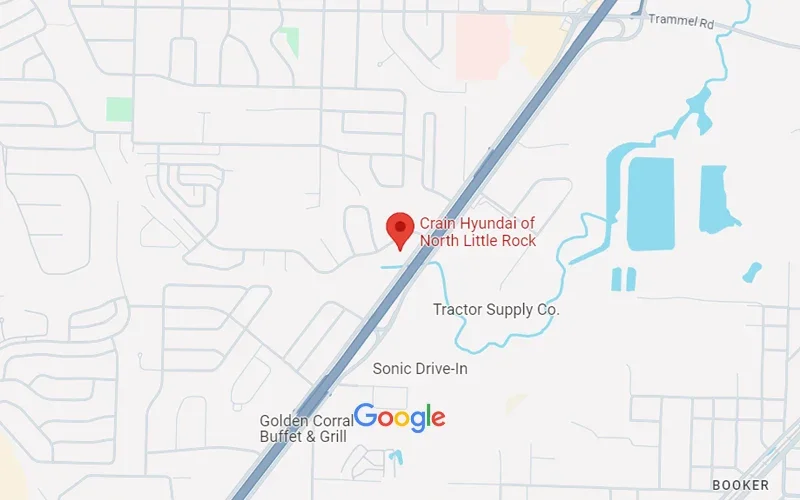
Replacing pads is very inexpensive, and new pads will give you the peace of mind of knowing that your brakes will work speedily and efficiently again. Call our service department today at Crain Hyundai of North Little Rock.
Connect with us


Recent Blog Entries
- 2026 Hyundai Santa Fe vs 2026 Honda CR-V in North Little Rock, AR
- 2026 Hyundai Palisade vs 2026 Toyota Grand Highlander in North Little Rock, AR
- 2026 Hyundai Santa Cruz vs 2026 Honda Ridgeline in North Little Rock, AR
- 2026 Hyundai Kona vs 2026 Subaru Crosstrek in North Little Rock, AR
- 2026 Hyundai Elantra vs. 2026 Toyota Corolla: A Central Arkansas Sedan Showdown
Categories
Crain Hyundai of North Little Rock
Address
5600 Warden Rd
North Little Rock, AR 72116
Phone
- Main 501-232-4162
- Service 501-232-4162
- Sales 501-232-4162
| Monday | 9:00AM - 7:00PM |
| Tuesday | 9:00AM - 7:00PM |
| Wednesday | 9:00AM - 7:00PM |
| Thursday | 9:00AM - 7:00PM |
| Friday | 9:00AM - 7:00PM |
| Saturday | 9:00AM - 7:00PM |
| Sunday | Closed |
| Monday | 7:00AM - 6:00PM |
| Tuesday | 7:00AM - 6:00PM |
| Wednesday | 7:00AM - 6:00PM |
| Thursday | 7:00AM - 6:00PM |
| Friday | 7:00AM - 6:00PM |
| Saturday | 7:00AM - 3:00PM |
| Sunday | Closed |
| Monday | 7:00AM - 6:00PM |
| Tuesday | 7:00AM - 6:00PM |
| Wednesday | 7:00AM - 6:00PM |
| Thursday | 7:00AM - 6:00PM |
| Friday | 7:00AM - 6:00PM |
| Saturday | 7:00AM - 3:00PM |
| Sunday | Closed |